
Jane's Patisserie » Recipes » Best Baking Recipes » Buttermilk Scones
Buttermilk Scones

*This post may contain affiliate links. Please see my disclosure for more details!*
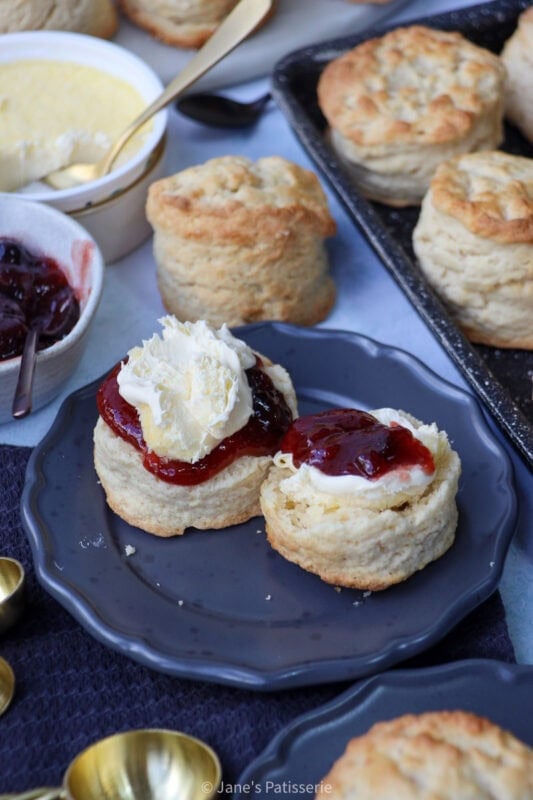
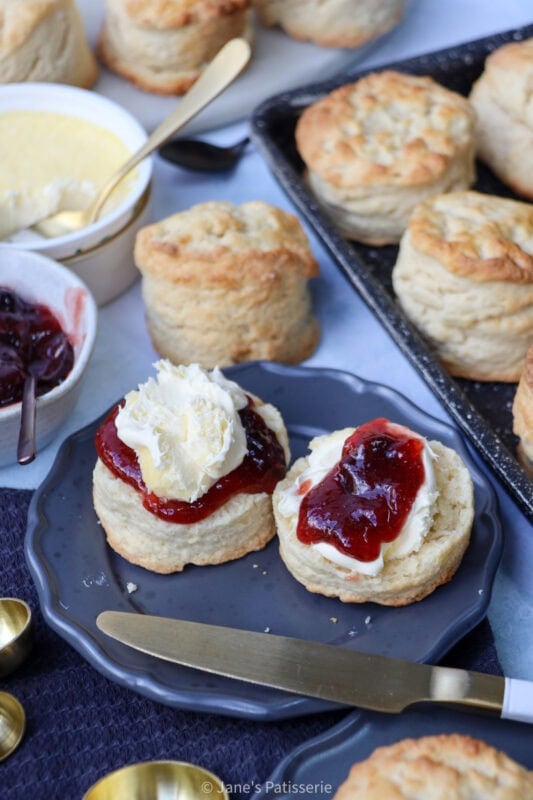
A delicious homemade buttermilk scone recipe perfect for a cream tea, afternoon tea, or whenever you want something simple and sweet. Ready to eat within the hour, they are soft, light and fluffy, and perfect served with jam and clotted cream.
Notes from The Patisserie
There is something so wonderfully delicious about a batch of freshly baked scones, and I have made many batches in my time. Having had a job in a tea room for a while, the practice behind the method was strong.
These beautiful buttermilk scones are golden on the outside, soft and fluffy in the middle, and are perfect served with a dollop of clotted cream and your favourite jam. These really are a classic… but the main question?
Do you pronounce it scone as in ‘cone’? or scone as in ‘gone’? And do you serve these the classic Cornish way with jam first and the clotted cream on top? Or the Devonshire way, with cream first, and jam on top?
Why do you use Buttermilk in scones?
Buttermilk is a magical ingredient that you may have come across in different baking recipes on my blog or in the world, or even a savoury dish here and there. Buttermilk is a natural bi-product of making butter, but is also something cultured itself for production for supermarkets.
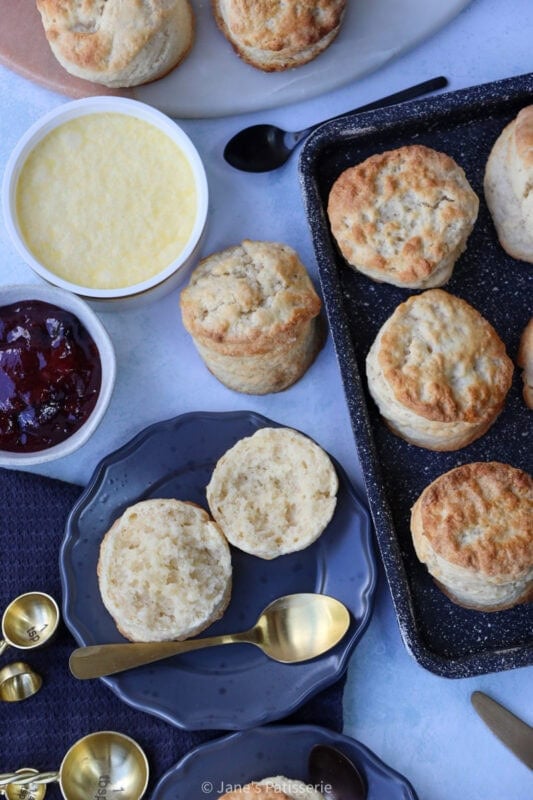
Whilst I have a delicious classic buttery scone recipe already on my blog, I have created another post specifically about buttermilk as I have had so many requests. Combining the cold butter with a hot oven, the buttermilk helps create soft fluffy layers in the scone that is just delicious.
Making your own buttermilk
Whilst you can either make your own butter, and use the liquid, or you can buy buttermilk (at often, great expense) you can also quickly make your own at home, to prevent you having to buy it.
You can make your own by combining 250ml of milk (or 1 cup) with 1 tablespoon of lemon juice or vinegar. Traditionally, I would use full-fat milk to have the best results in my baking, but really, you can use any milk.
I would pour the milk into a bowl/jug, add the lemon/vinegar, and stir. Leave this to sit for 5 minutes and then use in the recipe.
Top tips for the best homemade scones
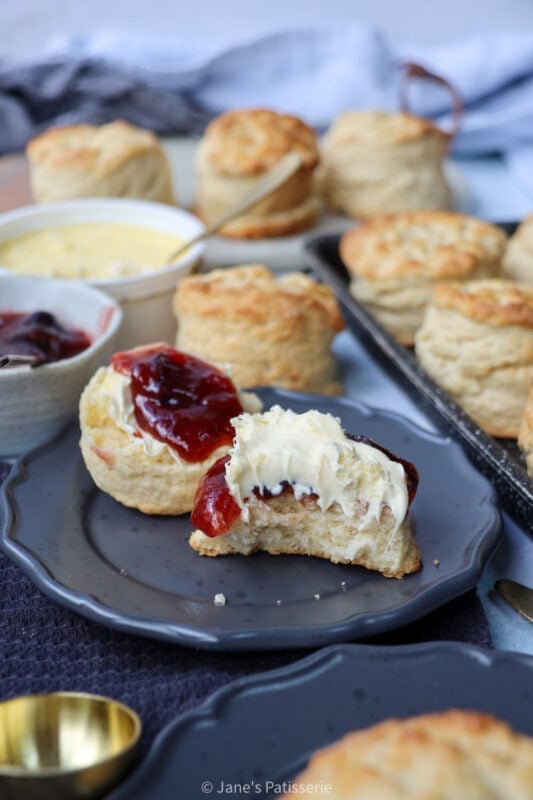
As much as eating and enjoying scones seems to be a huge part of British life, people often buy them as they can be tricky to make at home. Usually, it’s the process during the making that makes them harder to achieve, but here are some top tips to help you create the best homemade buttermilk scones.
- Use cold butter straight from the fridge – and make sure to use block butter, not a spread or margarine.
- Rub the butter into the dry ingredient mix to resemble breadcrumbs – you can use a food processor for this, but often this over works the dough so be careful. I do this part by hand.
- Avoid over mixing the dough – you really need to only mix the dough until it comes together. If you keep kneading the dough, it’ll overwork the gluten structure.
- Press the dough – instead of using a rolling pin, try simply pressing the dough onto the floured work surface with the palms of your hand, to prevent compressing it
- Pre-heated tray – make sure to preheat the tray in the oven, as the heat underneath will help kick-start the rise of the scones
- Don’t twist – when using a cutter, do NOT twist it to remove the scones. Flour the cutter first, press down firmly, and do not twist as this can make the scones bake at odd angles
Serving suggestions
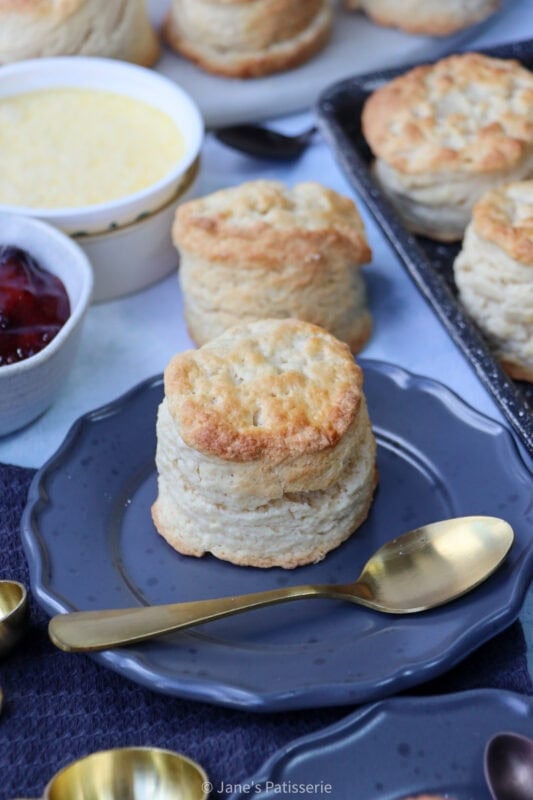
As mentioned, the typical serving for me is clotted cream, and jam. Personally, I spread (usually) strawberry jam onto my scone, and then dollop the clotted cream on top. However, there are no rules, and there are lots of delicious ways to serve scones
- Different flavoured jams – raspberry, cherry, summer berry, etc
- Whipped cream instead of clotted cream
- A spread of butter
- Lemon curd
- Fresh berries
Of course, these buttermilk scones would be a great part of a spread for afternoon tea, or made for a cream tea, but that is up to you.
FAQs
Can I make these in advance?
Yes, you can. They will last well for a few days, but are best on the day of baking.
What if I don’t have any buttermilk?
Make your own! See the instructions above for how to make buttermilk in general. For exact amounts, use 170ml of full fat milk, and 1.5tsp of lemon juice/vinegar to make your own
Why didn’t my scones rise?
It’s worth checking the top tips for making your own scones above, but usually it’s because of over working the dough, twisting the cutter when shaping the sconces, or using out of date products.
Can I use plain flour?
Yes! You can use two level teaspoons of baking powder, per 150g of plain flour. However, that is a large amount of baking powder for this recipe, so we would recommend using 3 tsps. Mix in before using in the recipe.
What cutter did you use?
I used a metal set (as I find them better over plastic) and used the smooth wide instead of ridged.
Buttermilk Scone Recipe
A delicious homemade buttermilk scone recipe for light and fluffy scones, perfect served with clotted cream and jam.
Print
Pin
Rate
Servings: 8 scones
Ingredients
- 475 g self raising flour
- 1 tsp baking powder
- pinch of sea salt
- 75 g caster sugar
- 175 g unsalted butter (cold and cubed)
- 175 ml buttermilk (see notes)
- 1 tsp vanilla extract
- milk/egg wash
Instructions
- Preheat the oven to 220ºc/200ºc and preheat a large oven tray
- Add the flour, baking powder, salt, butter and sugar to a bowl
- Rub together with your finger tips to a breadcrumb texture
- Add the buttermilk and vanilla and mix together as little as possible until it combines. I use a spatula and my hands to do this.
- Press down gently onto a floured surface to about 3-4cm thick
- Cut out with a floured cutter – do not twist to get them out – I use a 5-6cm cutter and make 8-10 scones
- Once they are all cut out, place onto the preheated tray
- Brush the tops with egg wash or milk
- Bake for 12-15 minutes until golden
- Leave to cool for 15-20 minutes, and enjoy warm, or cool fully.
Notes
- These are best on the day of baking, but will easily last for 2+ days
- You can freeze the scones once baked for 3+ months.
- I use this set of cutters for these scones
Storage and Freezing
These buttermilk scones are best on the day of baking, but will easily last for 2+ days at room temperature. You can warm them through again in the microwave or in the oven for a few minutes.
You can freeze the scones once baked for 3+ months. You can also freeze the scones before baking. Bake directly from frozen but at 2-4 minutes extra baking time
Fancy something else?
These scones are obviously delicious, but I have a few others that might tickle your fancy…
- Lemon Blueberry – a delicious scone for the summer months
- Apple crumble – something cosy for the colder months
- Cheese – delicious savoury alternative
- Fruit – another classic delicious bake.
It says see notes for buttermilk but there’s no notes on it. I don’t have butter milk, would whole milk work?
There is a section on the blog post on how to make your own x
If I don’t have a cutter can I pour these into cupcake tins instead?
I would make a round of dough, and use a knife to portion into triangle shaped scones instead x
I made these scones today and they were tasty (quite buttery!) but very crumbly and not exactly light in texture. I’m an experienced baker and run a home baking business. Usually Jane’s recipes are spot on but this scone dough was much drier than any I have made before. I chilled after rubbing the butter in and cut through the buttermilk to avoid making the mixture tough. I couldn’t get the dough to come together without compressing it firmly as it was so crumbly.
I wondered if the buttermilk measurement is correct as my instinct would be to add more? My go-to Good Housekeeping recipe uses 150ml milk for 225g flour. The equivalent liquid would be over 300ml for this recipe.
Can I ask why you chilled the dough? You don’t need to, and that could likely have caused a problem if the mixture was too cold. You just need to mix the dough together until it comes together – it might be worth watching a video of the recipe on instagram/tiktok/facebook. I can’t comment on someone else’s recipe, but having made these several times now through developing the recipe I can confirm that the measurements are all correct.
can you add the flavours of your other scones to these ones
How much lemon do you add to the milk to turn it into buttermilk?
It’s written on the post x
Hi Jane, have you trialled these with GF flour by any chance? Thanks!
How do you make your buttermilk pls, it does say in the notes.
There is a section on the blog post about it