
Jane's Patisserie » Recipes » Best Baking Recipes » Homemade Cinnamon Rolls!
Homemade Cinnamon Rolls!

*This post may contain affiliate links. Please see my disclosure for more details!*
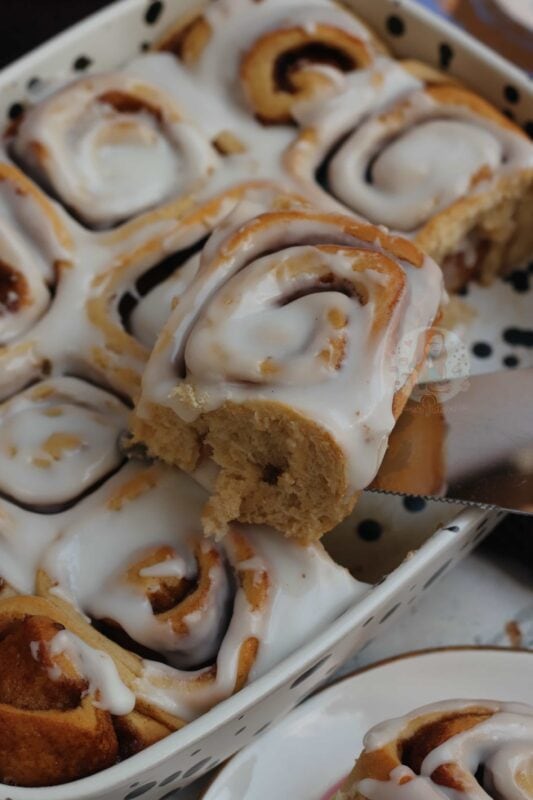
These homemade cinnamon rolls are soft, fluffy, and loaded with a sweet cinnamon-sugar swirl. Made with an enriched yeast dough, they require 15 minutes of hands-on prep, 20 to 25 minutes to bake, and a total of 3 hours of proving time.
Ingredient notes & tips
The foundation of a spectacular cinnamon roll is an enriched yeast dough. Unlike regular bread dough, an enriched dough contains butter, milk, sugar, and an egg. This combination weakens the gluten strands slightly, resulting in a beautifully soft, tender, and cake-like crumb rather than a chewy texture.
The absolute golden rule when working with yeast is managing your liquid temperature. When you warm your full-fat milk, it must be lukewarm, roughly 38°c. If the milk is too cold, the yeast will stay dormant and your dough won’t rise. If it is piping hot, it will instantly kill the yeast, leaving you with flat, heavy bricks. Aim for a comfortable warm bath temperature before pouring it into your dry ingredients.
- Flour – I use strong white bread flour to provide the high levels of gluten required for this dough
- Yeast – I use dried active yeast – but you can use quick yeast (same amount) or fresh yeast (use 28g). Some yeasts need activating before use so check package instructions.
- Sugar – caster sugar provides the right texture and flavour profile for the dough, brown sugar is used later for the filling
- Butter – I always use unsalted block butter as you don’t want want to be salting this dough as it could react with the yeast, stunting it’s rising potential
- Milk – this must be full-fat milk as the high fat content is essential to provide the rise and texture we are looking for
- Vanilla – this will provide the sharpness and sweetness throughout the dough
- Egg – I use one large egg


The ultimate gooey cinnamon filling
To achieve that iconic molten, caramelized center, the balance of the filling is critical. I use a generous combination of softened or melted unsalted butter, light brown sugar, and a full two tablespoons of ground cinnamon.
Using light brown sugar instead of white caster sugar is essential here. The natural molasses content in brown sugar melts down beautifully into the butter during the bake, creating a dark, sticky, and deeply flavourful syrup that wraps around every single layer of the dough swirl.


Perfecting the topping and glaze
A traditional cinnamon roll is simply incomplete without a sweet finish. This recipe features a classic, thick vanilla icing sugar glaze that sinks into the warm crevices of the rolls right out of the oven.
However, if you want to elevate them to standard bakery style, you can easily transform this into a decadent cream cheese frosting. Simply beat 50g to 100g of full-fat block cream cheese into the icing sugar and butter mixture for a beautifully tangy contrast to the sweet cinnamon interior.

FAQs
Can I make these cinnamon rolls the night before?
Yes, this is a brilliant time-saver for a fresh morning breakfast. Follow the instructions right up until you place the cut rolls into your baking dish for their second prove. Instead of leaving them at room temperature, cover the dish tightly with cling film and pop it into the fridge overnight. The cold environment slows down the yeast. In the morning, bring the rolls back out to room temperature for 30 to 45 minutes to finish puffing up before baking as normal.
Why didn’t my cinnamon rolls rise during the proving stage?
This usually happens if your milk was hot enough to kill the yeast, or if the room they were left to prove in was far too cold. Ensure your proving bowl is placed in a warm, draft-free spot, such as an airing cupboard or an oven that is turned off but has a bowl of boiling water placed at the bottom.
What is the cleanest way to cut the rolls without squishing them?
While a very sharp serrated knife works well, the ultimate baker’s trick is to use a piece of unscented dental floss or clean sewing thread. Slide the thread underneath the rolled dough log, cross the two ends over the top, and pull them tightly in opposite directions. It slices clean through the dough effortlessly without flattening the round shape of your rolls.
Can I substitute full-fat milk with a dairy-free alternative?
Yes, you can swap the full-fat milk for unsweetened almond, soy, or oat milk at a 1:1 ratio. Keep in mind that because alternative milks have a lower fat content, the dough may turn out slightly less rich, but it will still rise and bake beautifully.


Homemade Cinnamon Rolls Recipe
Delicious and sweet homemade cinnamon rolls. Easy to bake, and even more delicious to eat.
Print
Pin
Rate
Servings: 12 Rolls
Ingredients
The Dough
- 600 g strong white bread flour (plus extra for dusting)
- 14 g dried active yeast
- 75 g caster sugar
- 90 g unsalted butter
- 275 ml full fat milk
- 1 tsp vanilla extract
- 1 large egg
The Filling
- 45 g unsalted butter (melted)
- 175 g light brown sugar
- 1-2 tbsps ground cinnamon
The Topping
- 300 g icing sugar
- 1 tsp vanilla extract
- 3-4 tbsp water
Instructions
- Sift the flour into a large bowl, and add the caster sugar and yeast. Mix these together so its all evenly distributed.
- Rub the butter into the mixture so it resembles bread crumbs, like you would when making scones.
- Gently heat the milk until warm – but not piping hot. If heating in a pan, you want it to just about start having steam come out of the pan.
- Add the milk, vanilla, and egg to the dry ingredients.
- Knead the dough together for 7-10 minutes. It will be sticky at first, but it will soon come together. I use my KitchenAid with the dough hook to make this easier.
- Once kneaded, it will be springy to touch, and not sticky.
- Transfer into a lightly oiled bowl, and cover the top of the bowl with cling film. Let it rise for 1-2 hours, or until doubled in size.
- Whilst the bread is proving, whisk together the light brown sugar, and ground cinnamon for the filling. Leave to the side for now.
- Once the dough has risen, transfer to a lightly floured work surface, and roll out to a large rectangle. Mine ends up being about 50cmx30cm.
- You want it to be as even a rectangle as possible so its easier to roll up, and the dough can be thin here.
- Gently brush the surface with the 45g of melted butter, and then sprinkle over the sugar/cinnamon mix.
- Roll the dough from long side to long side, so that a ~long sausage~ is formed. Cut this evenly into 12 pieces.
- I cut the middle, and then the two halves into two more, and then each into three pieces to get my 12.
- Using a large rectangular baking dish, mine was 30cmx24cm roughly, put them in. They won’t touch yet, but you want four rows of three basically.
- Cover the dish with clingfilm, and let them rise for another hour or so. By the end, they should all touch.
- Towards the end of the dough rising, preheat the oven to 180ºc / 160ºc fan so that when its finished rising, you can put it straight in the oven.
- Bake in the oven for 20-25 minutes, until golden brown and cooked through.
- Leave to cool, and then make the icing. Simply whisk together the icing sugar, vanilla and water until a thick icing paste is formed, and then spread over the rolls.
- Enjoy by breaking apart and eating all the gooey cinnamon goodness.
Notes
- These are best on the day of eating, but will last covered for a couple of days.
- I use this KitchenAid Mixer

Storage and freezing
These homemade cinnamon rolls are undoubtedly at their absolute best when eaten warm on the day of baking, but they will keep incredibly well for up to two days when stored in an airtight container at room temperature. To restore that fresh-from-the-oven texture on days two and three, simply pop an individual roll onto a plate and microwave it for 10 to 15 seconds to soften the dough and melt the cinnamon filling back down.
If you want to freeze your bakes, you can freeze the fully baked rolls (ideally un-iced) for up to three months by wrapping them tightly in cling film and foil; simply thaw them at room temperature and warm them in the oven for 5 minutes before glazing. Alternatively, you can freeze the raw dough rolls directly in their baking dish after cutting them; when you are ready to bake, let them defrost and complete their second rise overnight in the fridge before putting them straight into a hot oven the following morning.
Related recipes
This recipe is based quite a lot on my lemon & blueberry sweet rolls recipe, because I just love it so much. I’ve never had an issue when baking them, and I just adore the lemon and blueberry flavours… but the classic is cinnamon really.
I adore my baked cinnamon doughnuts recipe, because its warm and cinnamon-y, and these are just as good. A bit heavier admittedly because they are an actual dough, but still so cosy and warm. I realise it is now coming into spring and then summer, but I love cinnamon year round.
Thank you for this delicious recipe. I can’t wait to try them. I m not very good baking with yeast. What temperature do you prove the dough? Can I use the airing cupboard to prove the dough?
Thank you.
Pat
Hiya! I believe the optimum temperature for proving time is 25c!xx
These are amazing and as always great steps to follow. These actually are a favourite of mine to both eat and bake lol. Ive struggled recently with some rolls proofing more than others and couldn’t figure for the life of me why. So I bought a probe to test the milk temperature as obviously too hot can kill the yeast, however always followed your notes on just seeing steam come out the pan. It actually was around 140f so far too high so trying it with the probe this time, and 2nd proof in the fridge overnight. Let’s see how that works. As always, delicious and yummy and moreish and glad I found you! Xx
Hi Jane – super excited to try these at the weekend! Quick question about the icing – whenever I try make an icing sugar icing (icing sugar and water) it always turns out really runny and clear as opposed to thick and white like your pictures. Where am I going wrong?
Hey! Instead of using a baking dish can I just put them on the baking tray so that they won’t touch each other?
Big fan of your blog!
Hello! You can do but the baking time is designed for them all to be touching. Thank you so much x
Planning I making these tomorrow, just curious if a cream cheese icing would be better for these?
Yes it would be lovely!
Hi Jane, if I prepped this up to the second prove and left in the fridge overnight, would I need to then give it an hour or so in the morning out of the fridge or do you think it could go straight from the fridge to the oven?
Many thanks – Sally
Love your recipes, my favourite if I had to pick would be the Bakewell blondie 😋.
I would bake straight from the fridge but for a bit longer – but taking out for a while first would be good! x
Hi Jane! Why the crust of my rolls become crispy instead of soft?
The outside of the dough thats been exposed in the oven will naturally be harder than the inside!
I left mine in oven for 20 minutes and they were burnt on the bottom and most of the filling ended up melting out and becoming burnt onto the tray. Also I used wholemeal bread flour which I wouldn’t do again as they didn’t taste very nice! 😕 many other recipes by Jane I’ve tried have been successful so I’m assuming it’s something I’ve done wrong.
I’ve tried other recipes, but this is by far the best. Easy to follow and works beautifully. Absolutely delicious and a weekend family favourite. Thank you!
Love how easy this recipe is – just waiting on the first prove and wondered if I need to grease or line the dish/tin before putting them in? Don’t want them to stick (it’s a non-stick tin that I plan to put them in to bake). Thank you!
I don’t personally as I use a lovely dish and it doesn’t need it! x
Hi Jane,
I have about 75g of brown sugar. Am I able to substitute it?
Hii! Yes you can use caster sugar or dark brown soft sugar!x
Would I be able to make the dough the day before? Thank you!!
You can prep up until the second prove the day before – and do the second prove (when its ready in the baking dish in the correct shapes) in the fridge over night x
Amazing – I’ve never made enriched dough before but these came out fabulously! These were a bit of spontaneous bake so we didn’t have the ingredients for the icing and they were still delicious. Can’t wait to make them again with icing.